NEW
MAZHER “FAKE SHEIK” MAHMOOD
Press Gang has uncovered two new examples of collapsed trials involving the former News of the World reporter.
They show that Mahmood could have been stopped decades before he was finally brought to book.
NEW
MAZHER “FAKE SHEIK” MAHMOOD
Press Gang has uncovered two new examples of collapsed trials involving the former News of the World reporter.
They show that Mahmood could have been stopped decades before he was finally brought to book.
REVEALED
The Times’ Asian sex gangs story of 2011 — there were warning signs during Andrew Norfolk’s investigation that his chosen narrative was suspect …
BREAKING
Press Gang begins the unravelling of Andrew Norfolk and the Times’ sensational Asian sex grooming gangs story of 2011.
Why were serious cases of white gangs abusing vulnerable boys and girls left out?
BREAKING
Guardian editor Katherine Viner corrects an article by barrister Adam Wagner which said a Labour activist claimed antisemitism complaints were “imagined”. It took her five years to do so ..
In 2020 lawyers in the phone hacking litigation made an extraordinary discovery.
In an archive handed over by News UK, parent company of the News of the World, they found a series of dramatic documents about a crisis at the paper in 1994.
It followed an investigation by Mazher Mahmood into a drugs and tickets racket at Wimbledon.
Piers Morgan was editor. Rebekah Brooks was a reporter.
The documents — we’ll call them the Wimbledon Papers in this article — are not in the public domain but a summary of their contents was included in a statement read out in court last year.
The story begins in August 1992 with a Mahmood article headlined “The Great Pension Book Fiddle”.
Mahmood claimed he’d exposed:
… the biggest social security scam ever carried out in this country. Police estimate that it raked in £230 million last year in London alone.
He handed over his evidence to the police and two men were charged with conspiracy to defraud the DHSS.
The trial took place in April 1994.
When Mazher Mahmood gave evidence, he said his story was based on information supplied by a confidential source.
The defence believed that this informant had threatened one of the defendants — and asked that Mahmood’s source be identified.
Mahmood, on oath, insisted that his informant was not the person alleged to have threatened the defendant.
The next day, police told the defence that Mahmood had not been telling the truth.
The Wimbledon Papers include a letter written by a prosecution solicitor. He said police:
… had discovered that Mahmood’s informant … was in fact the same person referred to by the defence and [was] also a police informant who was assisting them with a number of other matters of great importance.
The judge indicated that he was minded to order the prosecution to name Mahmood’s informant. The solicitor noted that the police were not
… happy for the informant’s identity to be revealed as this would jeopardise a number of other, important investigations.
The prosecution offered no evidence and the case collapsed.
This case marks the first occasion when Mazher Mahmood gave misleading evidence in the witness box.
No newspaper, including the News of the World, reported the collapse of the court case — it was to be nearly three decades before the reasons surfaced.
The Wimbledon Papers also explore another Mazher Mahmood story, just two months after the pension book trial.
This time it was a front page splash: “Wimbledon Vice Scandal”.
Mahmood told the paper’s 4.8 million readers:
The News of the World has infiltrated a vice, drugs and tickets racket where the wealthy can buy best seats around the Royal Box.
… hookers guzzle champagne in marquees crammed with nobility and bishops, then return to hotels for orgies and lesbian shows.
Mahmood passed his evidence over to the police. He wrote:
A spokesman for the Metropolitan Police promised action. “We’re grateful for the information the News of the World has provided.
“We’ll investigate the allegations throughly …”
That investigation was to prove embarrassing for the Fake Sheik and the News of the World.
The Wimbledon Papers include a note from a drugs squad detective.
He noted that Mahmood had unlawfully obtained four tickets for Wimbledon from a tout named “Alan” as well as cocaine and the services of two prostitutes.
He added:
It would appear from the article that the reporter has participated in criminal activities without the correct authority and may even have placed himself in a situation where he may be liable to criminal prosecution.
His report was considered by more senior officers.
A detective inspector got in touch with the Met’s intelligence unit, SO10. He wrote:
I have held conversations with S010 and it would appear that the author of the newspaper article is known to them in an unfavourable context.
This “unfavourable context” was Mahmood’s role in the collapse of the pension book trial earlier that year.
SO10 were concerned that if a prosecution was to take place as a result of the Wimbledon story, this material was likely to become public.
There was no prosecution. No action was taken against Mahmood.
Lachlan Murdoch
The events outlined in this article are only part of the story.
The papers themselves remain confidential.
On Tuesday Press Gang wrote to Lachlan Murdoch, chairman of News Corps in New York, asking him to make them public.
We asked for an answer by close of play yesterday. He did not reply.
Rogue Journalist
The events of 1994 were a stark warning that Mazher Mahmood was a loose cannon.
The News of the World ignored these warnings.
So did police and prosecutors.
When scores of criminal cases relying on Mahmood’s evidence came to trial, judges refused to allow their legal teams to attack his track record.
This fatally shackled defence barristers — and the result was a series of convictions.
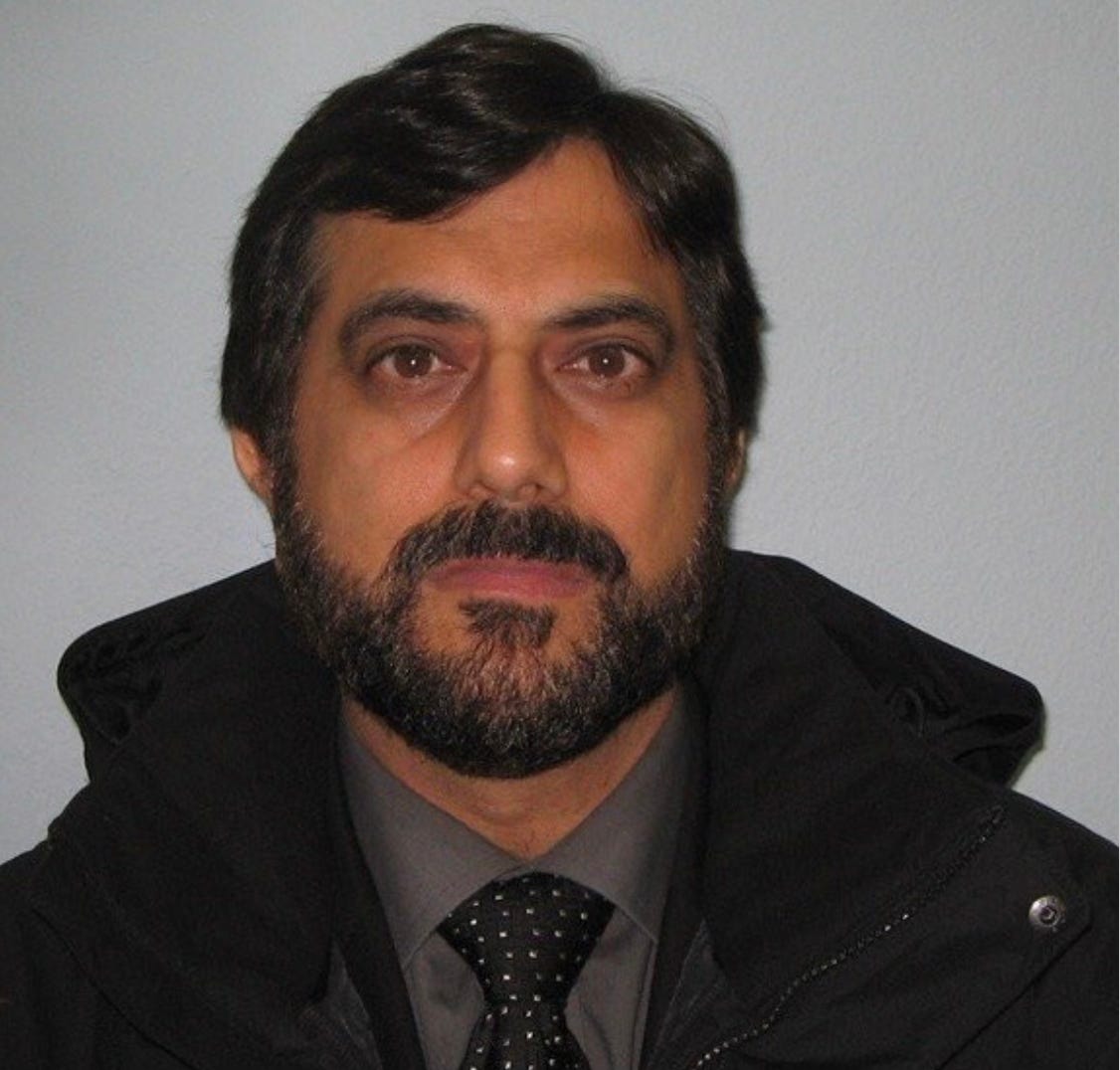
Among those gaoled were London’s Burning star John Alford and the entertainer Alex Smith. Both insist they were framed by Mahmood.
Among those who were convicted but escaped prison sentences were the disc jockey Johnnie Walker and Lord Hardwicke.
But many of the cases collapsed — including that involving Rhodri Giggs, brother of the Manchester United footballer Ryan Giggs — as a result of problems with Mahmood’s evidence.
These setbacks failed to stop the Fake Sheik juggernaut.
Rupert Murdoch was personally warned — in a Press Gang letter in 2012 — that Mahmood was a “serial perjurer”.
A similar letter was sent to the Metropolitan Police.
Both warnings were ignored.
It wasn’t until 2014 that justice finally caught up with Mahmood.
The climax came in the Tulisa Contostavlos case.
Just as in the 1994 pension book trial, Mahmood had given misleading testimony.
When he initially gave evidence he said he hadn’t spoken to his driver, Alan Smith, about a statement he’d given to police.
But the singer’s lawyers discovered that Smith had changed an earlier draft. In the first version he gave evidence that supported the singer’s claim that she disapproved of drugs.
Lawyers also discovered that the changes had been made after Mahmood discussed the issue with Smith.
He’d committed perjury. The trial was stopped and Tulisa Contostavlos, who had been facing a gaol sentence, walked free. It was a close shave.
Mahmood was gaoled for 15 months. His driver Alan Smith was given a 12 months suspended sentence.
In a strange twist, lawyers trying to overturn the convictions of Mahmood’s victims, including John Alford, now believe Alan Smith is the also the “Alan” who supplied drugs to Mahmood in the 1994 Wimbledon vice story …
Ends
UPDATE — FRAMED
Within a couple of hours after this article — about Mazher “Fake Sheik” Mahmood’s criminal conspiracy at the News of the World — was posted last week, News UK’s Executive Vice-President Daisy Dunlop, Director of Corporate Affairs, emailed:
Your letter to Lachlan Murdoch has been passed to me. You will of course be aware that he has no knowledge of historical matters concerning Mr Mahmood.
Please address any further correspondence for comment from the company to myself.
Daisy Dunlop did not answer our questions — would the company make public a series of papers that showed Mahmood was lying on oath as early as the early 1990s?
And — how did News UK gain copies of internal Scotland Yard files?
We asked again.
Daisy Dunlop replied:
We don’t have any comment. This matter is the subject of live litigation and is being dealt with in court.
CORRECTIONS
On 12 May 2024 three corrections were made to this article:
— the Wimbledon Papers were disclosed in 2020 not 2021 as we said
— we said John Alford’s court of appeal application had failed. In fact, he hasn’t (yet) submitted an appeal
— we left out the sentences imposed on Mazher Mahmood and Alan Smith.
The article has been corrected.
RECOMMENDED
Articles
Nick Davies Did the Murdoch empire hack MPs for commercial ends? Prospect magazine, June 2024
Nick Davies How Murdoch’s company magicked away 31 million emails Prospect magazine, June 2024
It is fashionable in some journalistic circles to say that the phone hacking scandal is old hat. These two articles, by the former Guardian reporter who helped to break the phone hacking scandal, show the issue is alive and kicking.
Website
The campaign “for a free and accountable press” was launched in 2011: “We work closely with victims of press abuse and are happy to help advise all members of the public. We are not affiliated to any political party.”
Book
Piers Morgan The Insider: The Private Diaries of a Scandalous Decade Ebury Press 2005
Autobiographies are a rich source of material for investigative journalists — and Morgan’s is one of the most potent. In it he reveals just how close he sailed to the wind as editor of the News of the World and the Daily Mirror. The book formed the bedrock of the Press Gang series A Pretty Despicable Man.
CORRECTIONS Please let us know if there are any mistakes in this article — they’ll be corrected as soon as possible.
RIGHT OF REPLY If you have been mentioned in this article and disagree with it, please let us have your comments. Provided your response is not defamatory we’ll add it to the article.
NOTE
This article was originally published on the Press Gang Substack platform — to read posts as they are published you can sign up for a free subscription at https://paddyfrench.substack.com
—————————————————————————————————————————————————————
Rupert Murdoch has no love for the British royal family.
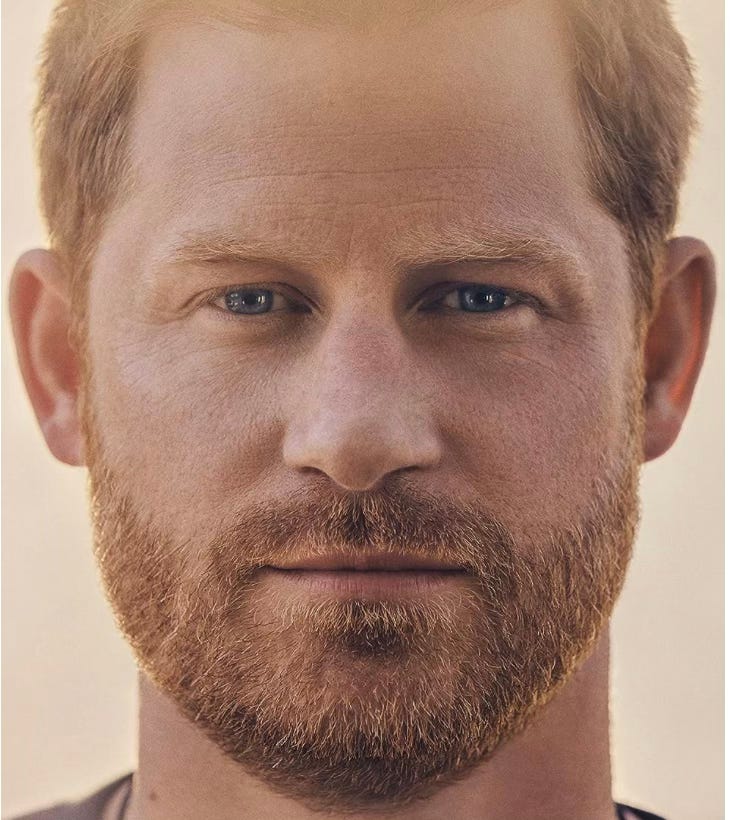
And Prince Harry hates Murdoch — he’s declared war on the press baron’s British empire.
In his autobiography Spare Prince Harry talks about the relentless pursuit of paparazzi throughout his life, especially two that he calls Tweedle Dumb and Tweedle Dumber.
Many of their pictures ended up in Murdoch papers:
They’d run alongside me, taunt me … Many paps wanted a reaction, a tussle, but what Tweedle Dumb and Tweedle Dumber seemed to want was a fight to the death.
They always seemed to know where he was. He discussed this with his brother William: “How do they know? How do they always know?”
Harry adds:
It was around this time that I began to think Murdoch was evil. No, strike that. I began to know that he was. First hand.
Once you’ve been chased by someone’s henchmen through the streets of a busy modern city you lose all doubt about where they stand on the Great Moral Continuum.
… I didn’t care for Murdoch’s politics, which were just to the right of the Taliban’s.
I couldn’t think of a single human being … who’d done more damage to our collective sense of reality. But what really sickened and frightened me … was Murdoch’s ever expanding circle of flunkeys: young, broken, desperate men willing to do whatever was necessary to earn one of his Grinchy smiles.
And at the centre of that circle … were these two mopes, the Tweedles.
Last month the legal team representing Harry in his misuse of private information action against Murdoch’s News Group Newspapers, applied for permission to include articles from 1994 and 1995.
Up until now the court has only allowed articles published in 1996 and after.
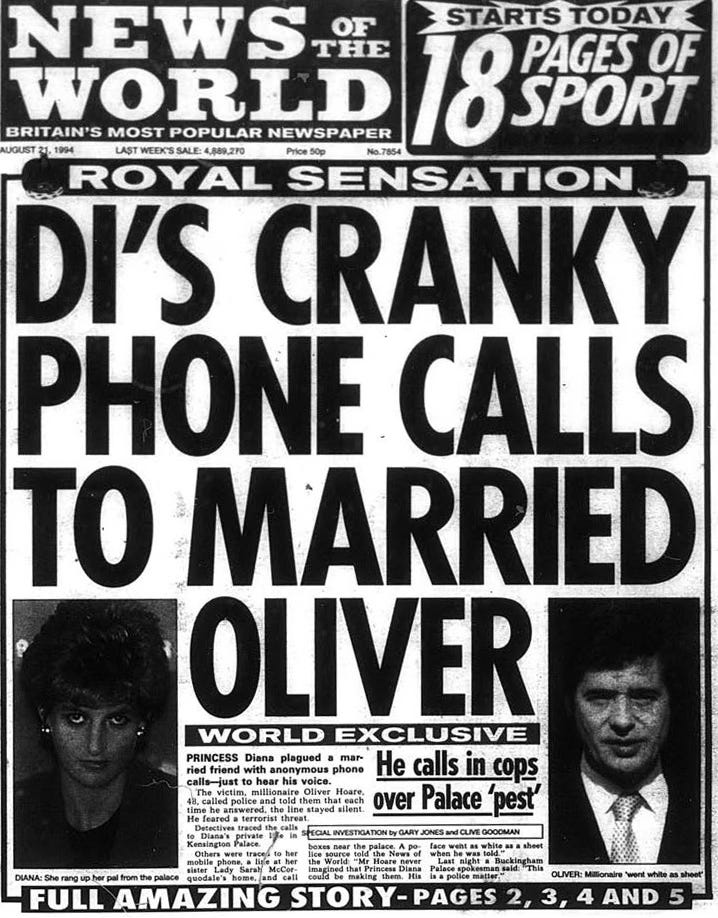
One of the most significant of the new articles is a 1994 News of the World exclusive revealing the contents of a confidential Scotland Yard report confirming that Princess Diana had made anonymous phone calls to a friend.
At the time the paper’s editor was Piers Morgan and Rupert Murdoch was personally involved.
The story is important because the evidence suggests the report was unlawfully sold to the News of the World by a police officer.
If Harry is successful in persuading the court to allow this article to be included in the case, it may lead to new information revealing the name of the officer involved and the News of the World staff who authorised payment.
Even though the events are now nearly two decades old, there is no statute of limitations in relation to criminal offences.
It was a Press Gang article in 2014 that first drew serious attention to the story. This was Whodunnit …? — the first of a long series about the career of Piers Morgan called “A Pretty Despicable Man.”
What follows is an updated summary of this article, including new material.
BATTLE ROYAL
In late 1993 the London art dealer, Oliver Hoare, a close friend of both Prince Charles and Princess Diana, reported a series of anonymous phone calls.
By January 1994 a police investigation discovered these calls were coming from numbers connected to Diana. The case was passed to Robert Marsh, head of the Metropolitan Police’s Royal Protection Squad.
Marsh’s wife Sandy Henney, a former Scotland Yard press officer, was assistant press secretary to Prince Charles.
Once he discovered that Diana was the source of the calls, Oliver Hoare declined to take the matter any further. The royal family were informed and the calls ceased.
All this took place in private. It was six months before the affair became public.
At the time, Charles and Diana were locked in an intense public relations battle in the wake of their separation.
In June 1994 Charles was interviewed on television by Jonathan Dimbleby. He admitted adultery.
In July Daily Express crime reporter John Twomey learnt about the anonymous calls and was preparing to splash the story.
The piece was spiked, apparently on the orders of Express chairman Sir David Stevens, a close friend of Princess Diana.
Almost immediately News of the World crime reporter Gary Jones got hold of the story. The detailed contents of the police investigation were read out to reporters.
Piers Morgan, the editor, ran the story as a “world exclusive”.
The day after the paper’s revelations, Princess Diana told the Daily Mail the story was false.
This sent Piers Morgan into a panic. In his memoirs The Insider he wrote that he couldn’t reveal that the paper’s story was correct “… without potentially exposing our source …”
He added:
And what if the report is a forgery?
I felt sick to the pit of my stomach.
Almost immediately Rupert Murdoch was on the phone:
Hi Piers, I can’t really talk for long but I just wanted you to know that your story is one hundred per cent bang on.
Can’t tell you how I know, but I just know.
The next day, the focus switched to the source of the News of the World story. Morgan wrote:
Everyone seemed to be blaming the police so I issued a statement saying it was categorically not a serving police officer, which is perfectly true.
Press reports suggested that at least a dozen officers had access to the report.
Met Commissioner Paul Condon ordered an internal probe into the leak but nothing was ever made public about the results.
Oliver Hoare, who died in 2018, spoke to Press Gang in 2014 on an off-the-record basis.
He said he was told that there was only one copy of the report and that it was locked in a safe when not in use.
BENT COPPERS
A month after the News of the World article, the Daily Mirror reported that Diana claimed the police report had been leaked to draw attention to her friendship with Oliver Hoare:
… humiliation heaped on the princess would counter any embarrassing revelations about Charles and Camilla Parker Bowles which might surface in a new book by Andrew Morton.
It was also clear she believed she was the subject of unlawful newsgathering:
Even when no one knows where I am going in my car there are people waiting for me at the other end.
In October 1994 she voiced these fears to Scotland Yard’s deputy assistant commissioner, David Meynell, who was in charge of royal protection.
Prince Harry, however, does not believe palace officials leaked the anonymous calls report to the News of the World.
In his recent application to include the article in his case, he says it “was based upon a police report that was unlawfully obtained” by private eyes.
They acted as brokers between the paper and the police source.
Allegations about bribing police officers have long been a feature of the unlawful news gathering scandal at the News of the World.
In March 2003 Rebekah Brooks — then Sun editor but previously features editor at the News of the World when the paper ran with the Princess Diana story — gave evidence before the Commons’ Culture, Media and Sport select committee.
Chris Bryant MP asked her if the Sun and the News of the World ever paid the police for information.
She replied:
We have paid the police for information in the past.
Two years later, in October 2005, another News of the World reporter — Mazher “Fake Sheik” Mahmood — admitted his involvement with corrupt detectives.
In a police interview he said:
I’ve got bent police officers that are witnesses that are informants.
Ends
RECOMMENDED
Article
Tom Lamont Prince Harry v the press Prospect, 2024
An inside account of the campaign that has shaped the legal actions against the Daily Mirror group and the Murdoch empire. It’s a long, 9,000 word piece focusing on the work of Dr Evan Harris, former Liberal Democrat MP turned press reformer. From a tiny office in Fleet Street, Harris and his associates marshal the information that helps to feed hundreds of legal actions.
Website
Byline Investigates
Founded by former News of the World reporter Graham Johnson, Byline Investigates describes itself as “a team of journalists crowdfunded to cover stories that other media organisations won’t.” It specialises in stories about unlawful news gathering by the big tabloids — the Murdoch papers, the Mirror group and, increasingly, the Daily Mail.
Book
Prince Harry Spare (Bantam, 2023)
A searing account of the royal renegade’s life, revealing his tortuous relationship with his father, King Charles, and his brother William, heir to the throne. A rare account of what it’s like to be on the receiving end of the ruthless tabloid press pack.
PRESS GANG
CORRECTIONS Please let us know if there are any mistakes in this article — they’ll be corrected as soon as possible.
RIGHT OF REPLY If you have been mentioned in this article and disagree with it, please let us have your comments. Provided your response is not defamatory we’ll add it to the article.


·
Comments

Top
Latest
A little known case reveals the full depth of Labour’s cynical treatment of Diane Abbott
APR 11
16 HRS AGO•
© 2024 Paddy French
Privacy ∙ Terms ∙ Collection notice
Substack is the home for great culture
25 April 2024
Gideon Falter and his Campaign Against Antisemitism are in the news this week for a publicity stunt that went wrong. They also claim two thirds of Britain’s Jews are considering leaving the country. The statistics tell a different story …
————————————————————————————————————————————————————
This Saturday Gideon Falter will be walking in central London during the latest demonstration calling for a ceasefire in Gaza.
The chief executive of the Campaign Against Antisemitism has said these demonstrations mean central London has become a “police-enforced Jew-free zone”.
Falter says that at the previous march on April 13 a police officer had told him he was “openly Jewish” and that he would be arrested if he didn’t leave the scene.
A video of the exchange was later challenged by a Sky News report which showed that the police officer intervened after Falter entered the march.
Falter’s claims that London is a Jew-free zone during pro-Palestinian demonstrations is literally incredible — hundreds if not thousands of self-identifying Jews, both pro-Palestinian and pro-Israel, were present either on the marches or on the fringes.
As of this evening, the CAA had not answered two important questions:
— why did it take six days before the video was released?
— were the men who accompanied Falter hired bodyguards?
The delay in releasing the video suggests that the CAA had difficulty in editing its original footage to produce the 55-second clip that gave the “right” impression.
Why did Falter need protection — was there a plan for him to provoke violence with marchers and then use the bodyguards to escalate the fracas?
One of these bodyguards has been identified as Vicentiu Chiculita, a contract manager for the SQR security group, founded by two former officers of the Israeli intelligence agency, Mossad.
“Faltergate” continues to unravel — good summaries of the story so far can be found here, here and here.
Falter’s claims about London being a “Jew-free” zone form part of a long-standing campaign to persuade British public opinion that Jews are considering leaving because of antisemitism.

Defending Israel has always been a key component of the CAA’s mission. It was formed in August 2014 partly as result of the British media’s alleged misreporting of Israel’s assault on Gaza.
Gideon Falter told the Jewish News:
… the obsession of the media, the fastidious disregard for the facts and the insistence on holding Israel to exceptional, impossible standards, helped to feed the oldest hatred. If you wanted to follow the news in Israel, it was almost impossible to do so by reading the British press; there were too many missing facts.
(Amnesty International estimated that more than 2,000, including some 500 children, were killed during Israel’s “Protective Edge” operation in July 2014.
These figures are dwarfed by the current catastrophe in Gaza with Israel killing more than 30,000 Palestinians — including a substantial number of innocent women and children.)
A year after its formation, the CAA settled on one of its main themes — that one in four British Jews have “considered leaving the country in the past two years” as a result of antisemitism.
By 2017 the organisation said the figure had risen to a third.
This claim came under fire from the Jewish Leadership Council. The JLC said the research was unrepresentative of UK Jewish opinion and expressed fears that the statistical analysis amounted to “scaremongering”.
Undeterred, the CAA continues to insist these figures hold good. Its website currently states that 42 per cent of “British Jews considered leaving Britain in the past two years, 85 per cent of them due to antisemitism in politics”.
The latter comment is mainly a reference to the CAA’s allegation that Labour under Jeremy Corbyn was institutionally antisemitic.
What’s the reality?
Every year, Israel produces statistics about immigration from the four countries with large Jewish populations: USA (6.3m), France (c440k) Canada (400k) and Britain (300k).
The figures show that the number of British Jews moving to Israel is low and has remained at virtually the same level throughout the last decade.
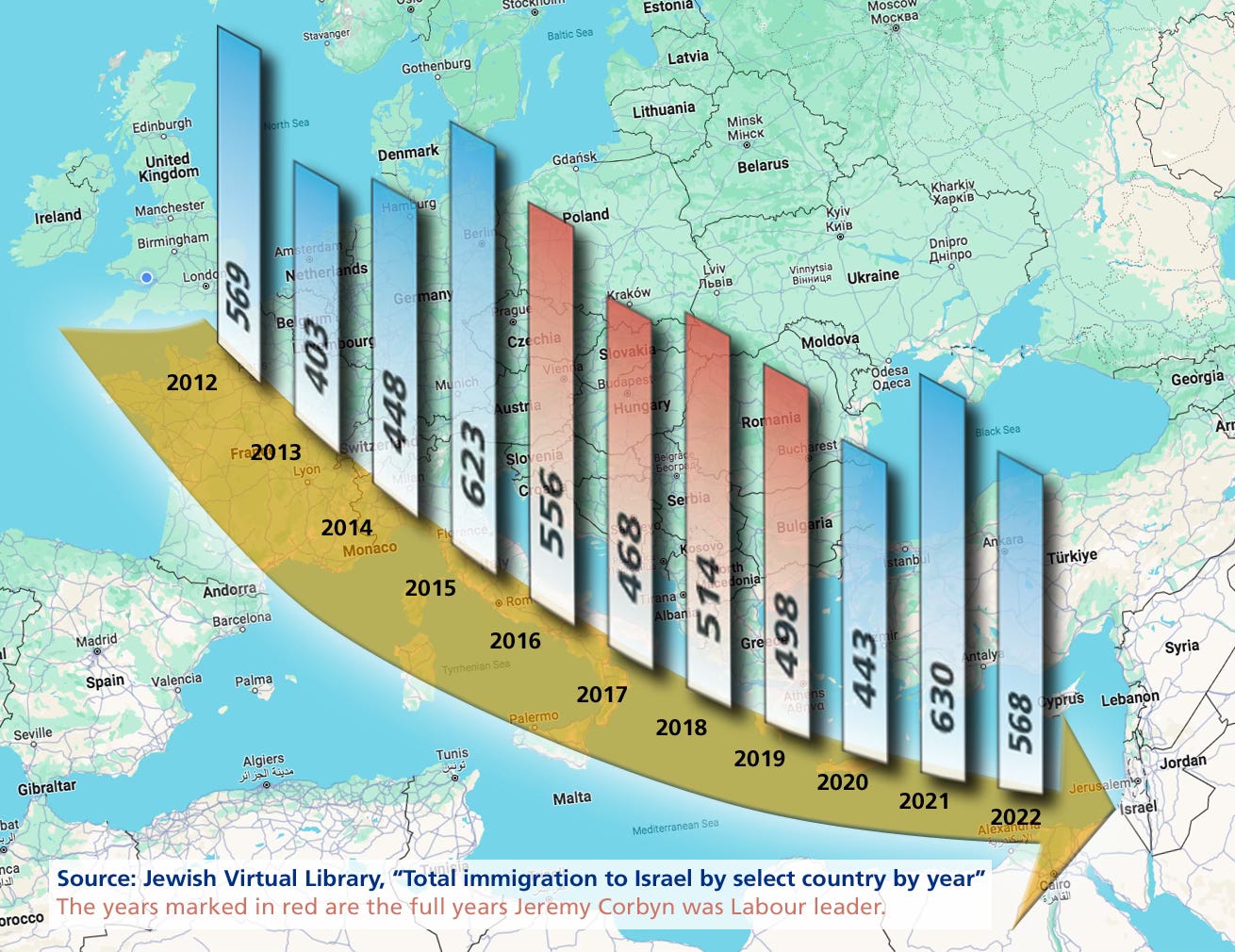
These figures also throw light on what was happening in the period Jeremy Corbyn was Labour leader. The CAA was in the vanguard of those calling him an antisemite.
In the four full years of Corbyn’s leadership the average number of Jews emigrating to Israel each year was 509.
The figure for the previous four years was slightly higher at 511 and the figure for the three years since is much greater: 547.
Jews could be emigrating to other countries, of course, but there are no available statistics. There is no evidence that British Jews are moving to countries like France or North America.
One reason why Jews are not leaving Britain is safety.
In France, where four Jews were murdered in the attack on a Paris supermarket in 2015, emigration to Israel is substantial — more than 2,700 people move to Israel each year.
The USA is also more dangerous than Britain, as shown by the 2018 attack on Pittsburgh’s Tree of Life synagogue in which 11 Jews perished.
And Israel, home to 7.2m Jews, is currently the most dangerous country on earth for Jews.
No Jew has been killed in an antisemitic attack in Britain in either the 20th or the 21st century. Although there are serious assaults, the number is mercifully low.
Every year, the Community Security Trust’s produces an annual Antisemitic Incidents Report. In 2023 it noted:
… none of these incidents was severe enough to be classed as Extreme Violence, compared to one incident in 2022.
(By contrast, anti-Muslim hatred is more lethal.
In 2015 an 81 year old grandfather, Mushin Ahmed, was murdered in Rotherham.
Makram Ali died in the 2017 attack near the Finsbury Park mosque in London.)
Britain’s Jews enjoy a high level of state protection. Every year the UK makes a grant of more than £18m to the Community Security Trust (CST) to help provide security at Britain’s Jewish schools and synagogues.
In addition, several high profile Jewish bodies are given charitable status and given dispensation to keep the identity of their trustees secret — including the CST and the Campaign Against Antisemitism.
The CAA does not disclose the source of its funding. Although its trustees are not identified, it does have “honorary patrons,” some of whom have been made public.
These have included, at various times, Labour MPs Margaret Hodge and Ian Austin, the Conservative MPs Sir Eric Pickles and Bob Blackman, Richard Kemp, former head of the British Army in Afghanistan, Lord Carey, the former Archbishop of Canterbury, and the libel lawyer Mark Lewis.
There has been criticism of some of these “honorary patrons”.
In December, in the middle of Israel’s bloody invasion of Gaza, Richard Kemp was in Jerusalem — alongside right wing author Douglas Murray — repeating his mantra that Israel’s IDF is the world’s “most moral army”.
When the CAA accused Keir Starmer of using the Holocaust memorial in Berlin as a prop for a political ad in July 2022, it was a step too far for former honorary patron Margaret Hodge.
She was, she tweeted, “fed up with the CAA using antisemitism as a front to attack Labour”.

The CAA has also been in trouble with the Charity Commission, one of Britain’s most timid watchdogs.
In October 2018 the regulator ordered the CAA to change the wording of a petition saying that Jeremy Corbyn was an antisemite and “must go”. The commission allowed the CAA to brand Corbyn an antisemite but insisted the charity to change the words “must go” to Labour “must act”.
A spokesperson said:
… there are rules that charities must follow. One of the most important of these rules is that charities must stress their independence from party politics and demonstrate party political balance.
In January last year the Charity Commission opened another compliance case against the organisation. A spokesperson said “We can confirm that the Commission is assessing concerns raised with us about the Campaign Against Antisemitism”.
Ends
CORRECTION
RECOMMENDED
Article
Naomi Klein We need an exodus from Zionism Guardian, 24 April 2024
In this astonishing polemic, Klein argues that Zionism is a “false idol” that “has betrayed every Jewish value”. She says that the world-wide pro-Palestinian demonstrations mark an “exodus from Zionism”.
Website
JVL represents left wing party members who support the Palestinians against Israeli repression. Its motto — “always being with the oppressed, never with the oppressor” — is a quote from Marek Edelman, a Jewish commander in the 19423 Warsaw Uprising. Many JVL members have falsely been accused … of antisemitism.
Book
Philo, Berry, Schlosberg, Lerman and Miller Bad News For Labour: Antisemitism, the Party and Public Belief Pluto Press, 2019.
A carefully researched examination of how a hostile press shaped public opinion on the issue of Jeremy Corbyn and antisemitism.
CORRECTIONS Please let us know if there are any mistakes in this article — they’ll be corrected as soon as possible.
RIGHT OF REPLY If you have been mentioned in this article and disagree with it, please let us have your comments. Provided your response is not defamatory we’ll add it to the article.
A little known case reveals the full depth of Labour’s cynical treatment of Diane Abbott
NOTE
This article was originally published on the Press Gang Substack platform — to read posts as they are published you can obtain a free subscription at https://paddyfrench.substack.com
—————————————————————————————————————————————————————
In a few weeks Diane Abbott will have been suspended by Labour for a year.
Her “crime” was to suggest that white Irish, Jewish and Traveller people “undoubtedly experience prejudice,” which she said is “similar to racism”.
“But they are not all their lives subject to racism.”
Abbott quickly withdrew the remarks and apologised.
The Board of Deputies of British Jews, one of the groups which claims to represent many of Britain’s 300,000 Jews, said her remarks were “disgraceful”:
We have written to Keir Starmer expressing our deep concern and asking for the whip to be removed.
Starmer immediately suspended her from the Parliamentary Labour Party pending an investigation.
Abbott remains a party member but, like Jeremy Corbyn, now sits as an independent MP.
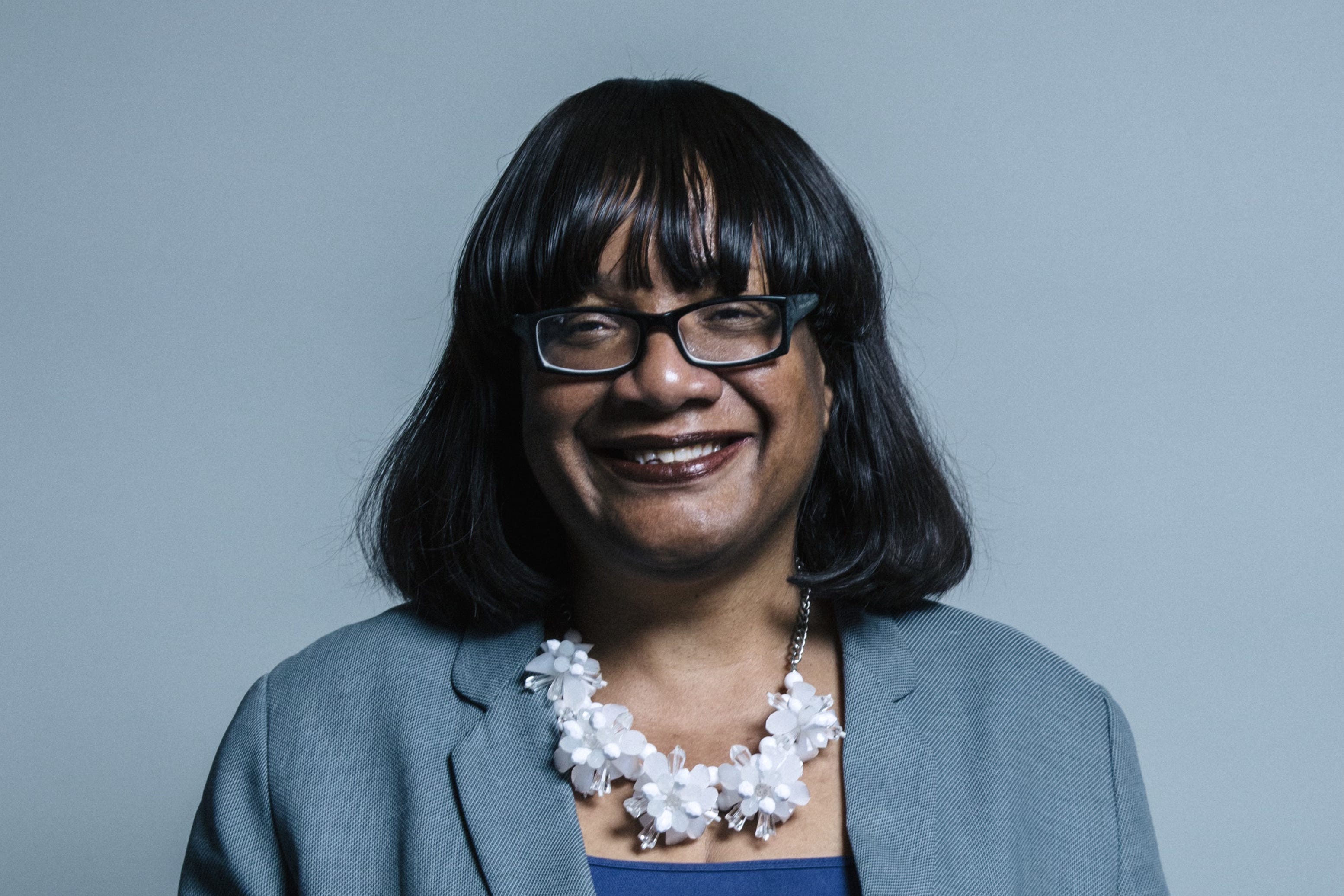
Now compare this draconian treatment with that of a Labour member who said of Abbott in December 2017 that “it’s about time she got put in a box with the lid fastened firmly”.
This story was broken by the Skwawkbox website.
The next day Skwawkbox reported that Andy Bigham, from Dudley in the West Midlands, had been suspended for making the comment .
What happened next, however, has never been reported in the mainstream media.
The story began when a large number of complaints, starting in April 2016, were made about Bigham.
In December 2017, after these had been ignored by the party’s complaints team, there were new complaints about his “coffin” comment about Diane Abbott:
One complainant argued that this “could be construed as a threat or instruction to carry out the threat”.
The previous year, in June 2016, fellow Labour MP Jo Cox had been murdered by a far right fanatic.
Despite the seriousness of Bigham’s comment, one complaints official initially noted:
“I don’t think this would be considered a death threat by the police or would warrant suspension”.
She added that “our advice would be a written warning and a reminder of our social media policy”.
A more senior official then intervened: Bigham’s comment was “disgusting” — “leave it with me”.
Bigham was then suspended.
The suspension lasted just two months. In February 2018, a complaints official lifted the suspension with a written warning.
Over the following three months there were more complaints about Bigham’s apparent support for the Conservative Party. No action was taken.
In June 2018 there was another complaint which again included the Abbott “coffin” comment. An official said that, because this issue had already been investigated, the party would be “unable to look into this matter again”.
He added that the party does not
discourage members from posting their views or entering into healthy debates on social media.
It was not until a complainant went directly to general secretary Jennie Formby that action was taken. She said Bigham’s support for the Tories was grounds enough to withdraw his membership.
He was then auto-excluded.
(This account is based on the internal party report, The work of the Labour Party’s Governance and Legal Unit in relation to antisemitism, 2014–2019, which was leaked in April 2020. Pages 537-543.
Keir Starmer was asked if he accepted this version of events. He did not reply.)
Bigham’s “punishment” for calling for Diane Abbott to be placed in “a box with the lid fastened firmly” was a brief suspension and a written warning.
Fast forward to March this year. When the Guardian revealed that businessman and Tory donor Frank Hester had said Diane Abbott “should be shot,” Starmer was quick to exploit the situation.
The Guardian quoted Hester’s comment in a meeting at the Leeds headquarters of his computer software company in 2019:
It’s like trying not to be racist but you see Diane Abbott on the TV and you’re just like, I hate, you just want to hate all black women because she’s there, and I don’t hate all black women at all, but I think she should be shot.
Hester has given the Tory party £10m, making him the party’s largest ever political donor. The Guardian calculated that government, NHS and local authorities had paid more than £440m to Hester’s companies since 2016. Hester, the sole owner, “collected dividends of £33.5m for the last five years for which accounts … are available.”
Hester told the paper he “accepts that he was rude about Diane Abbott in a private meeting several years ago but his criticism had nothing to do with her gender nor colour of skin”. The statement said Hester abhorred racism, “not least because he experienced it as the child of Irish immigrants in the 1970s”.
Hester’s remark caused a political storm. Prime Minister Rishi Sunak belatedly admitted the remarks were racist but refused to return the £10m Hester had donated.
When the issue was raised at Prime Minister’s Questions on March 13, Keir Starmer asked Sunak if he was:
… proud to be bankrolled by someone using racist and misogynous language when he said that the right hon. Member for Hackney North and Stoke Newington (Ms Abbott) ‘makes you want to hate all black women’?
Sunak replied that the “comments were wrong and they were racist. He has rightly apologised for them and that remorse should be accepted. There is no place for racism in Britain, and the Government that I lead is living proof of that.”
Starmer replied
Mr Speaker, the man bankrolling the Prime Minister also said that the right hon. Member for Hackney North and Stoke Newington should be shot. How low would he have to sink, what racist, woman-hating threat of violence would he have to make, before the Prime Minister plucked up the courage to hand back the £10 million that he has taken from him?
However, despite nearly 50 attempts to catch Speaker Lindsay Hoyle’s eye, Diane Abbott was not allowed to speak.
This afternoon, a spokeswoman for Hoyle denied that his decision not to call Abbott was due to pressure from Starmer:
No this is not true.
During Prime Minister’s Questions, the Speaker must select MPs from either side of the House on an alternating basis for fairness. This takes place within a limited time frame, with the Chair prioritising the 15 Members who are already listed on the Order Paper.
On 13 March 11 Opposition party members were drawn in the ballot, and four Government members. Due to limited time, there was not an opportunity for Members on the Opposition side who were bobbing to put their questions – and not everyone on the Order Paper was called.
Mr Speaker would have been open to a Point of Order being raised on this issue at the end of PMQs, but none was forthcoming.
Hoyle also denied that his actions were prompted by concerns that the Labour leader might deny him the peerage normally given to Speakers on retirement.
This tradition was broken when the previous Speaker, John Bercow, was refused a peerage. He had offended many Tories in the way he had handled Commons business.
Hoyle’s spokeswoman said:
This is untrue.
Starmer’s office did not reply to questions.
The Labour leader has also resisted calls to restore the whip to Abbott in the wake of the Hester affair.
Abbott has criticised Labour for sending out a fundraising email saying it was “fuming” about Hester’s remarks: “Hypocritical barely covers it,” she said.
She did not respond to questions.
Police investigations into Hester’s comments continue.
An Amnesty International study in 2017 found that Abbott, who was sent on average 51 abusive tweets a day, “receives an incredibly disproportionate amount of abuse and was the target of almost a third … of all abusive tweets we analysed”.
Ends
RECOMMENDED
Article
Rivkah Brown, How the Guardian editor in chief caved in to pro-Israel pressure, Novara Media, 12 March 2024
A fascinating account of how Guardian editor Kath Viner shapes the paper’s policy on the Palestine-Israel question and the alleged infuence of its powerful pro-Israel staff members.
Website
Skwawkbox
https://skwawkbox.or
@skwawkbox
It was Skwawkbox, run by Unite member Steve Walker, that first exposed the Andy Bigham case featured in this Press Gang article.
With 72,000 followers on Twitter, it’s an influential — and sometimes controversial — blog from a left wing perspective.
Book
Asa Winstanley, Weaponising Anti-Semitism: How The Israel Lobby Brought Down Jeremy Corbyn, (OR books, 2023)
The definitive account of how pro-Israel groups in the UK combined to play the antisemitism card against the former Labour leader. Even those who disagree with its thesis will find it a carefully researched and useful account of Corbyn’s leadership.
CORRECTIONS Please let us know if there are any mistakes in this article — they’ll be corrected as soon as possible.
RIGHT OF REPLY If you have been mentioned in this article and disagree with it, please let us have your comments. Provided your response is not defamatory we’ll add it to the article
Privacy ∙ Terms ∙ Collection notice
Substack is the home for great culture
Is the net closing in on Rupert Murdoch and Piers Morgan?
Did they pay a corrupt police officer for a secret Scotland Yard file on Princess Diana?
Prince Harry is on the warpath …
30 November 2022
Today judgment was handed down in the Ware v French libel case.
John Ware sued Press Gang editor Paddy French for £50,000 damages over his criticism of the 2019 Panorama programme “Is Labour Anti-Semitic?”
French withdrew from the case and did not take part in the trial which lasted an hour and 20 minutes on November 7.
Mr Justice Knowles awarded John Ware £90,000 in aggravated damages.
The judge also granted Ware a permanent injunction:
The Defendant must not, whether acting by himself or otherwise howsoever, publish or cause to be published any words to the following or similar effect: that the Claimant is a rogue journalist who had engaged in dirty tricks aimed at harming the Labour Party’s chances of winning the General Election by authoring and presenting an edition of Panorama in which he presented a biased and knowingly false presentation of the extent and nature of antisemitism within the party, deliberately ignoring contrary evidence.
Ware had told the court that French “had ‘thrown down the gauntlet’, which he would have been only too happy to have picked up, but, he said, the defendant had now ‘slithered away’ and behaved in a ‘cowardly’ fashion.”
Mr Justice Knowles said he agreed with John Ware’s KC, William Bennett, that French’s “attitude to these proceedings … had been one of contempt”.
Paddy French said:
“This case raises serious questions about press freedom in Britain.”
“I believe I am the first journalist to be sued by a reporter working for the BBC for criticising a BBC programme that that reporter was involved in making.”
“I am concerned that the Director General and the BBC board appear to have allowed the case to go ahead. “
“This raises the question of whether Ware v French is a SLAPP (Strategic Litigation Against Public Participation) action by proxy in order to smother debate about this controversial programme.”
“If it is, then it sets a dangerous precedent — Britain’s state broadcaster is permitting its reporters to engage in litigation against the Corporation’s critics.”
“If the action was not a SLAPP, it was certainly a breach of the long-standing tradition in the UK that journalists do not sue other journalists.”
“Journalists have other public platforms besides the courts to argue their case — and John Ware can command space in national newspapers when he chooses.”
“I am naturally disappointed that the case has ended in the way it did.”
“I would like to thank my legal team and the large number of people who have supported me in contesting it.”
“The judgment does not end the continuing examination of the Panorama programme.”
“I’m pleased that John Ware and his team have acknowledged that I am free to continue investigating the Panorama broadcast.”
“The full report on this programme will be published next year.”
 PRESS GANG